
The MHA Story
Learn about MHA's heritage
Last updated 1 February 2026
The Ministry of Home Affairs (MHA) was set up in 1959 when Singapore attained self-government. When Singapore joined the Federation of Malaysia in 1963, internal affairs became a federal responsibility.
Singapore’s Independence on 9 August 1965 saw the formation of the Ministry of Interior and Defence (MID), whose responsibilities included overseeing the Police Force and Immigration Department.
On 11 August 1970, MID was split into separate Ministries – MHA and the Ministry of Defence (MINDEF), with the former tasked to deal with matters relating to public safety, civil defence and immigration.
Through the years, MHA has played an essential role in Singapore’s nation building journey by ensuring a safe and secure home for Singaporeans. Today, MHA, which is also known as the Home Team, consists of the Ministry Headquarters and 10 agencies, including seven departments and three statutory boards1. While the various agencies have their own heritage and distinct responsibilities, some of which pre-date the Ministry’s formation in 1959, all share the same mission of keeping Singapore safe and secure.
The Home Team is constantly transforming to prepare itself to meet evolving challenges, and strengthening partnerships with the community to keep Singapore safe and secure.
[1] The seven departments are Singapore Police Force (SPF), Internal Security Department (ISD), Singapore Civil Defence Force (SCDF), Singapore Prison Service (SPS), Immigration & Checkpoints Authority (ICA), Central Narcotics Bureau (CNB), and Home Team Academy (HTA); while the three statutory boards are the Home Team Science and Technology Agency (HTX), Casino Regulatory Authority (CRA), and Yellow Ribbon Singapore (YRSG).
Pre-1959: The Early Years – Securing A New Nation
While the Ministry of Home Affairs (MHA) only took shape in 1959, some of its agencies, such as the Singapore Police Force (SPF), and the Singapore Prison Service (SPS), were already in existence far before 1959.
SPF traced its origins to soon after the founding of modern Singapore by Sir Stamford Raffles, with the establishment of the police department in 1820 to maintain law and order in the booming immigrant town.
SPS was institutionalised as a government department in 1946, serving as a custodial agency and managing prison facilities under the British colonial authorities.
1959-1970
1959
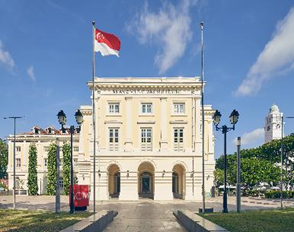
MHA was first housed at the former Empress Place Building (current Asian Civilisations Museum). Photo: Asian Civilisations Museum
Singapore achieved internal self-government for the first time since the arrival of the British. This meant that certain internal security matters, such as policing and immigration control, were under the local Government. The Ministry of Home Affairs (MHA) was then set up to provide peace and order. It was housed at the former Empress Place Building and remained there until 1963.
1963
Singapore joined the Federation of Malaysia. MHA (including social welfare) was renamed Ministry of Social Affairs, as internal security matters such as police and immigration were transferred to the central government in Kuala Lumpur.
1965
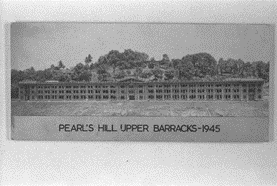
MID was re-located to Pearl’s Hill, in the vicinity of Chinatown, in November 1965. Photo: Singapore Police Force Collection, courtesy of National Archives of Singapore
The Ministry of Interior and Defence (MID) was established when Singapore seceded from Malaysia and gained Independence. MID handled internal and external security matters, including the Police Force, Immigration Department and armed forces. The MID was first housed in borrowed space at the former Empress Place Building, before moving to the Pearl’s Hill’s Upper Barracks in November 1965.
1967
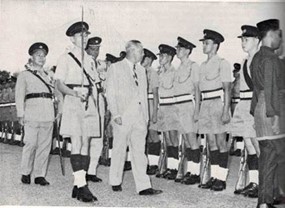
Passing out parade of the first batch of Part-time Police National Servicemen (Special Constabulary), 1968. Photo: Singapore Police Force
The National Service (NS) (Amendment) Bill was passed on 14 March 1967. National Service in the Home Team began with the introduction of Part-time Police National Service (PNS) in the Special Constabulary and the Vigilante Corps. Part- time PNS was phased out in 1981.
1970
MID was split into two ministries – MHA and Ministry of Defence (MINDEF) on 11 August 1970. MHA’s role was to deal with matters relating to public security, civil defence, and immigration. MHA remained at Pearl’s Hill until it moved to Phoenix Park in 1977.
1971-2000
1971
The Central Narcotics Bureau (CNB) was established in November 1971 as the primary drug enforcement agency entrusted with coordinating all matters pertaining to drug eradication.
1975
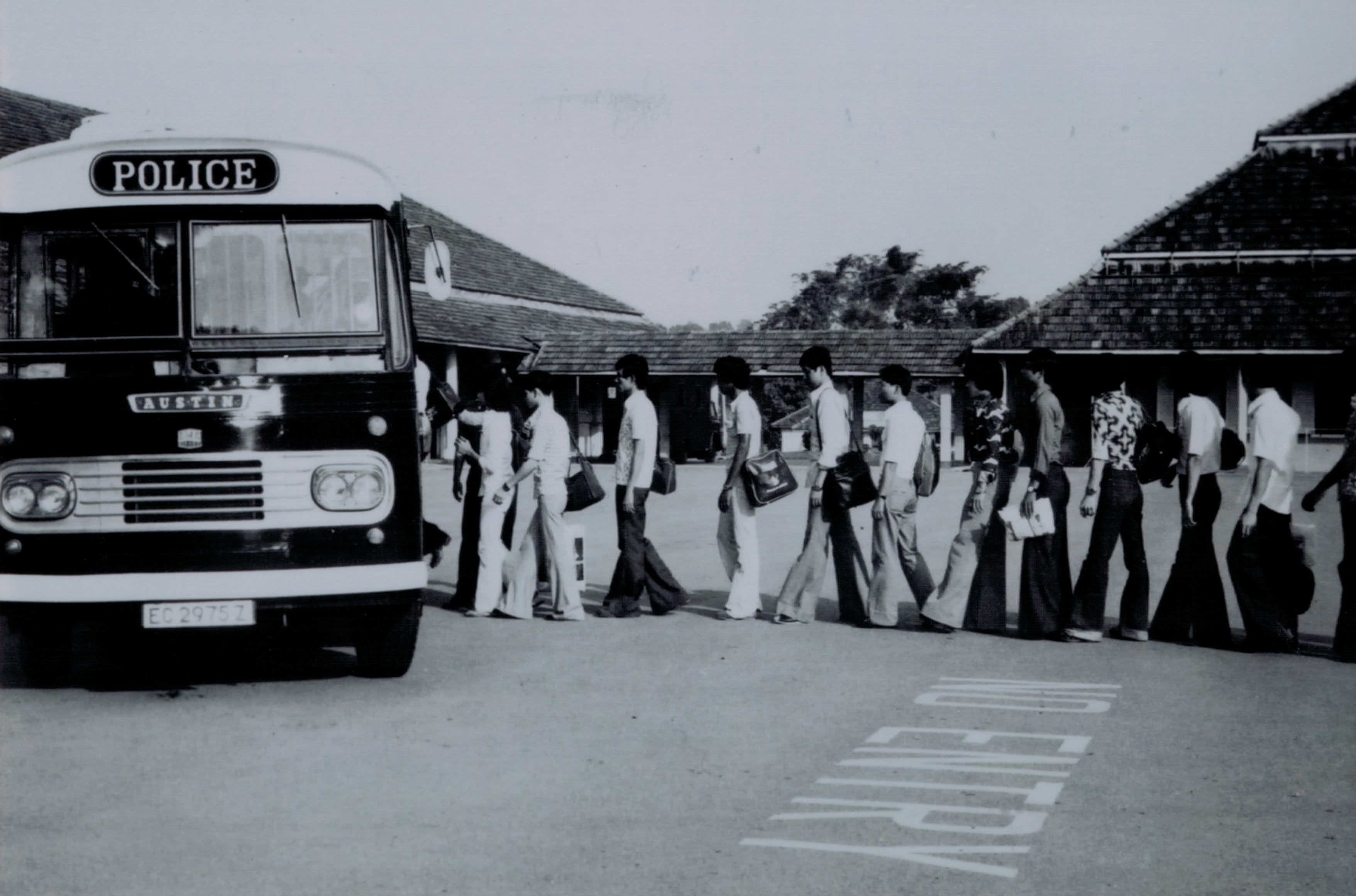
Police enlistees reporting for Full-time Police National Service, 1975. Photo: Singapore Police Force
To further strengthen the internal defence of Singapore following independence, Full-time Police NS was introduced in 1975, eight years after the start of the Part-time Police National Service (PNS) scheme. The first intake of 211 Full-time Police National Servicemen who enlisted on 24 July 1975 supplemented the regular Force by performing policing duties that included the protection of key installations, team policing and station duties.
1977
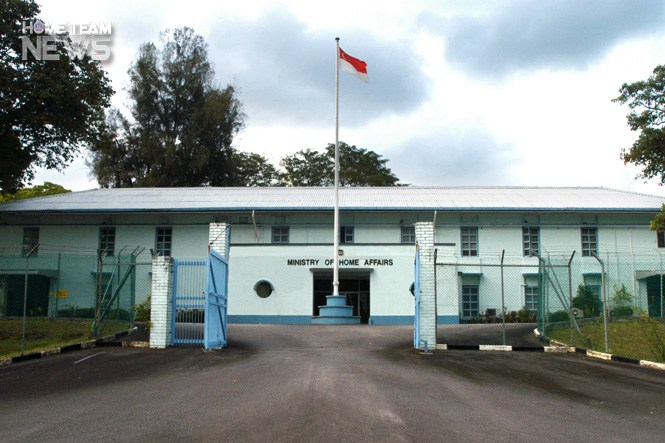
MHA moved to Phoenix Park at Tanglin Road in 1977, after seven years at Pearl’s Hill.
MHA moved to Phoenix Park, where it stayed for over 20 years. The emblem of the Allied Forces’ Southeast Asia Command featured the phoenix, and Phoenix Park was known as the “Little Whitehall of the Far East". During the period MHA was sited at Phoenix Park, it dealt with challenges ranging from criminal gangs and the rise of drug abuse to communist subversion, espionage and terrorism.
1989
The Singapore Civil Defence Force and the Singapore Fire Service were formally integrated in April 1989 to form the Singapore Joint Civil Defence Force (SJCDF) due to the similarity in roles and functions of the two organisations. SJCDF was subsequently renamed the Singapore Civil Defence Force (SCDF) in 1992.
1997: Working as a team to make Singapore our safe and secure best home
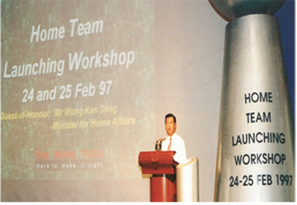
Mr Wong Kan Seng, former Minister for Home Affairs at the Home Team Launching Workshop on 24 and 25 Feb 1997.
The Home Team concept was launched in February 1997 by former Minister for Home Affairs, Mr Wong Kan Seng. It centres around the idea that agencies in the Home Team have many purposes but ultimately all have one common mission, which is to keep Singapore safe and secure. The Home Team concept further galvanised the way in which Home Team agencies collaborate and work together.
2000
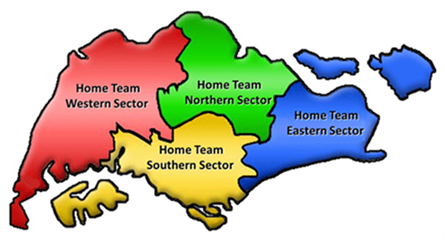
The four Home Team sectors represented geographically across the Singapore map.
The Home Team Sector concept was established to deepen the spirit of collaboration among Home Team Departments. All Home Team ground units, such as police stations, and fire stations, were divided into four geographical sectors – North, South, East, and West, enabling ground officers to work together on joint operations, training, and community engagement initiatives.
2001-2020
2001
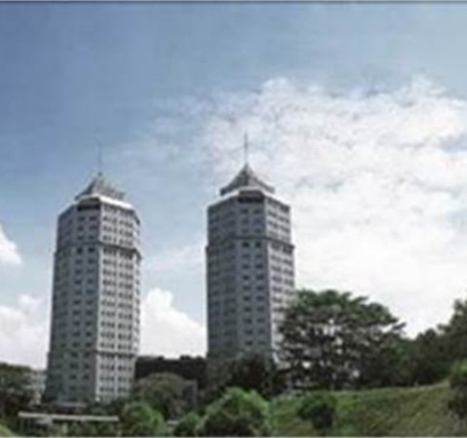
The “twin towers”, with MHA Headquarters co-located with Police Headquarters at the New Phoenix Park in Irrawaddy Road since 2001.
The MHA Headquarters, together with the SPF Headquarters, moved from Phoenix Park at Tanglin Road to a new complex with better-equipped facilities at Irrawaddy Road on 18 August 2001. The new complex is aptly named New Phoenix Park to pay homage to MHA’s heritage.
2002
The Home Team mission was introduced – “We work as a team, in partnership with the community, to make Singapore our safe and secure best home" – and the Home Team core values of Honour and Unity were introduced.
2003
The Immigration & Checkpoints Authority (ICA) was formed in April 2003 with the merging of Singapore Immigration & Registration (SIR) and the checkpoint operations of the Customs & Excise Department (CED), to strengthen border controls in the wake of the September 11 terrorist attacks.
2006

An example of CEP publicity material used to enhance awareness of the programme.
The Community Engagement Programme (CEP), the precursor to the SGSecure national movement, was launched to build community resilience and to foster a community that is unified and prepared for emergencies. This was in the aftermath of the London terrorist bombings in July 2005. The Home Team strengthened relationships with community groups.
2006
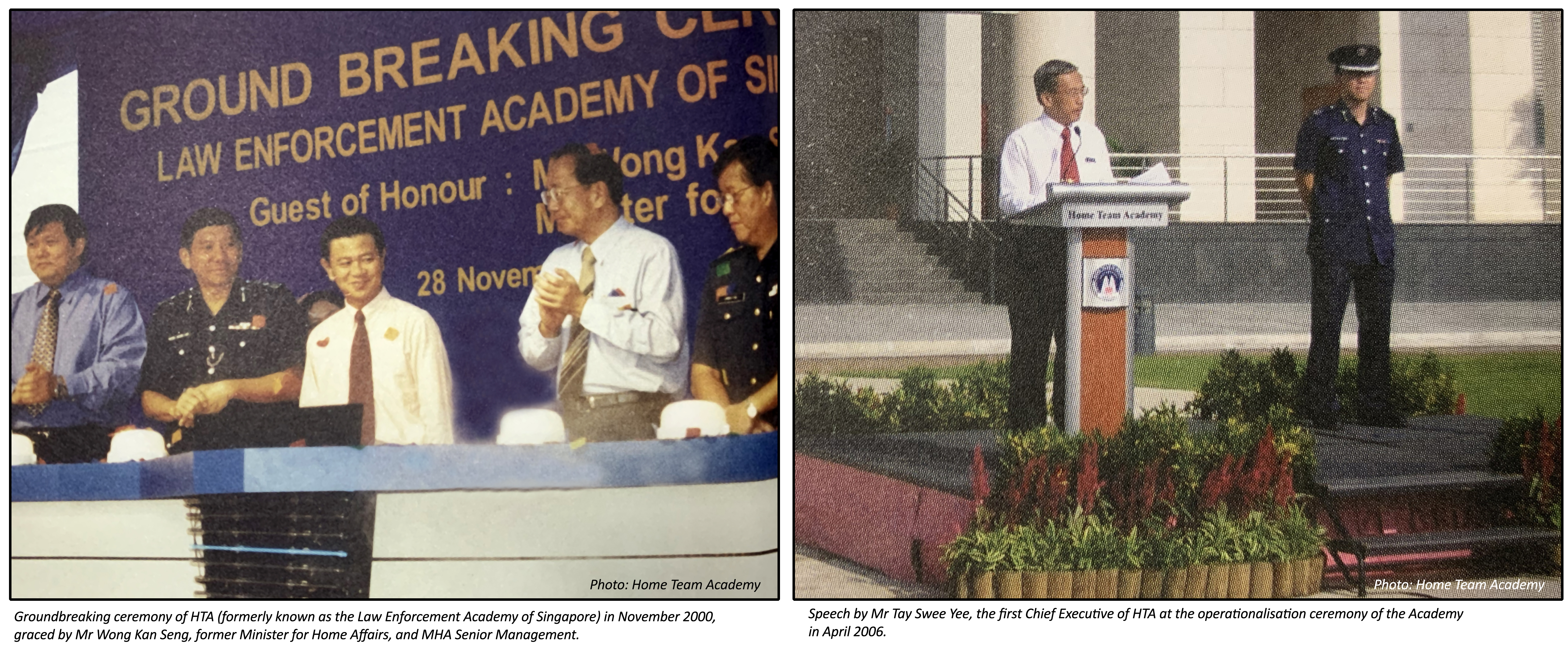
The Home Team Academy (HTA), the training arm of the Home Team, was officially opened in September 2006. Its opening was a further embodiment of the Home Team concept as, with the exception of SCDF’s Civil Defence Academy (CDA), the training schools of other Home Team Departments are now co-located within HTA’s premises. HTA provides joint training and fosters a common Home Team identity and ethos among Home Team officers.
2008
The Casino Regulatory Authority (CRA) was established as a statutory board under MHA in April 2008, and is responsible for regulating the casino industry in Singapore.
2011
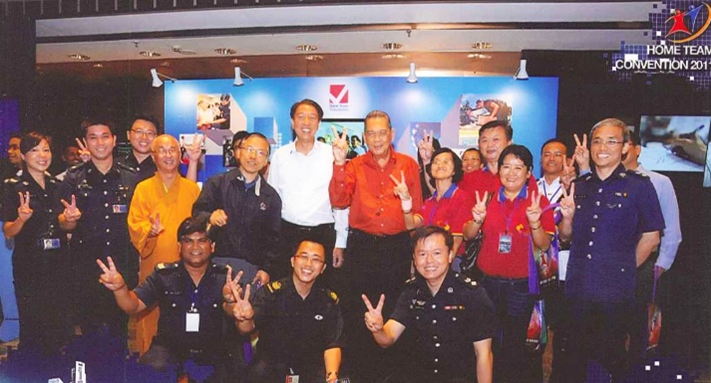
The HTVN was launched by Mr Teo Chee Hean, former Minister for Home Affairs at the Home Team Convention 2011.
The Home Team Volunteer Network (HTVN) was formed on 15 July 2011 to work with the various Home Team Departments and their volunteers to better contribute to the safety and security of Singapore.
2013
The Home Team Operations Cluster framework was introduced, as Home Team collaborations were restructured along MHA’s key functional areas for greater operational synergy. The four clusters are Public Security, Maritime Security, Border Security, and Drug Control. The existing North, South, East and West Sectors were subsumed under the Public Security Cluster.
2013
The inaugural Home Team Festival was held from 8 to 10 November 2013. It is a biennial public engagement event to showcase the Home Team’s latest operational capabilities and highlights the Home Team’s partnership with key stakeholders in keeping Singapore safe and secure.
2015

The ICC insignia is a symbol of pride and common identity to encourage closer collaboration and coordination among Home Team officers working together at the domains. Photo: Immigration & Checkpoints Authority
The Integrated Checkpoints Command (ICC) was first launched on 2 January 2015, at the Land Domain, followed by the Sea Domain on 1 April 2015, and lastly at the Air Domain on 1 October 2015. The ICC strengthens the coordination and synergy among the different Home Team Departments working at the checkpoints.
2015
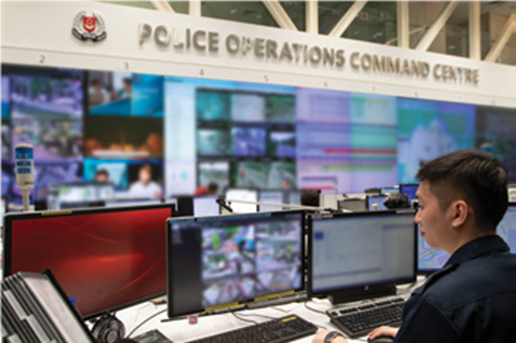
The POCC was launched in Apr 2015, and it brings together SPF, SCDF, ICA and CNB operations room officers under one roof which enables a joint security response. Photo: Singapore Police Force
The Police Operations Command Centre (POCC) was launched in April 2015, serving as the SPF’s new nerve centre which monitors incidents, takes 999 calls, and coordinates its responses. The POCC also allows officers from SPF, SCDF, ICA and CNB to come together to sense-make a common situation picture which enables a joint security response, and is a step towards operationalising the concept of the Home Team Operations Centre (HTOC), where the operations centres of SPF, SCDF, ICA and CNB will be brought together under one roof to manage routine and major incidents.
2015: Towards a future-ready Home Team
The Home Team embarked on Home Team Transformation 2025 to transform the Home Team to meet future challenges. The transformation journey is part of continuous improvement and to deal with operating challenges characterised by emerging threats, higher public expectations, increased workload, and manpower constraints.
2016
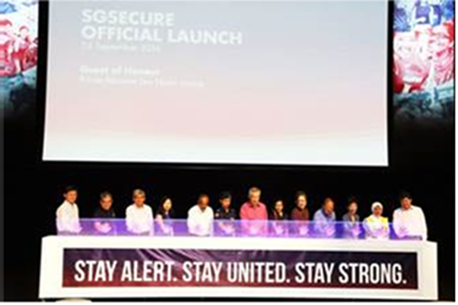
SGSecure was launched in September 2016, as a national movement to sensitise, train, and mobilise our community to play a part to prevent and deal with a terrorist attack. It is how the whole of Singapore can come together in response to the terror threat, and safeguard our way of life, with every member of the community playing their part.
2017
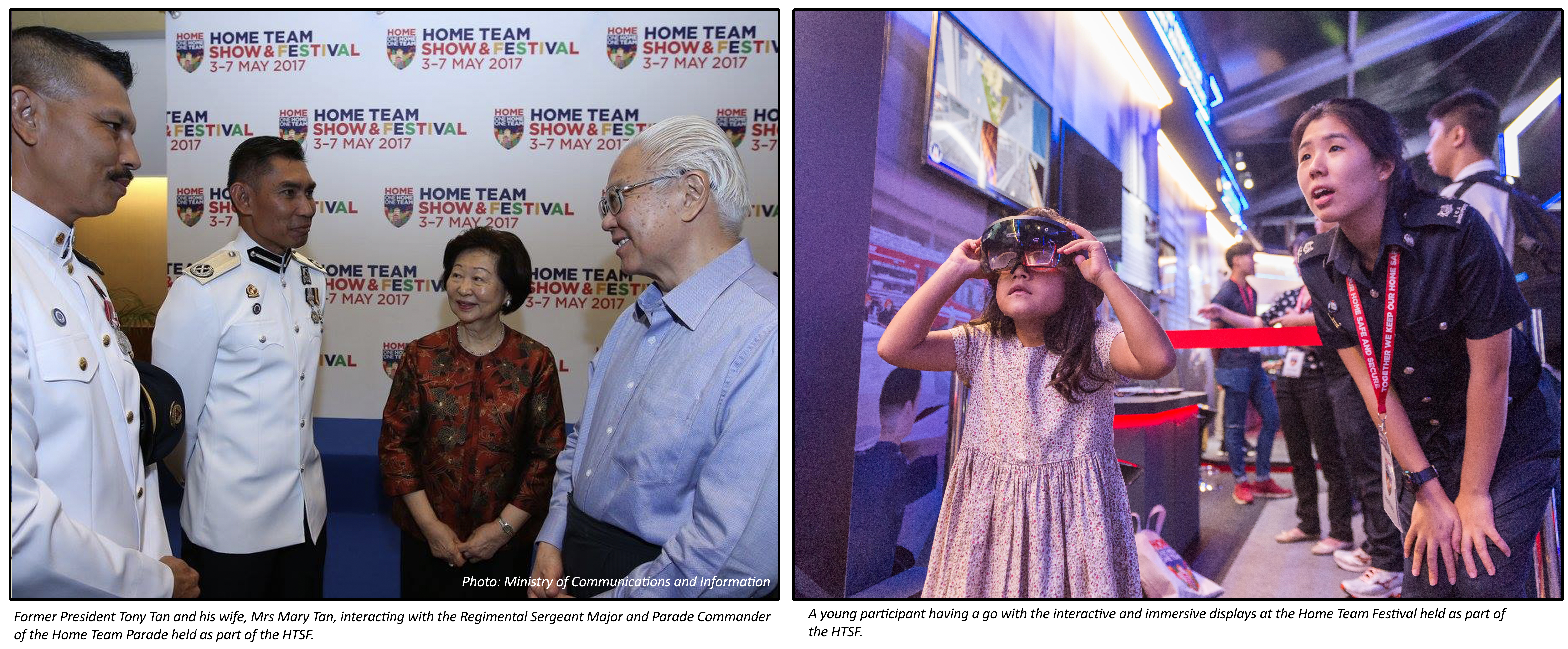
The first Home Team Show and Festival (HTSF) was held from 3 to 7 May 2017 at the Singapore Sports Hub precinct. Former President Tony Tan graced the Gala Show as the Guest-of-Honour. The event was organised to pay tribute to all Home Team officers. It also marked 20 years since the launch of the Home Team concept, and was held in conjunction with the 50th anniversary of National Service (NS).
2019
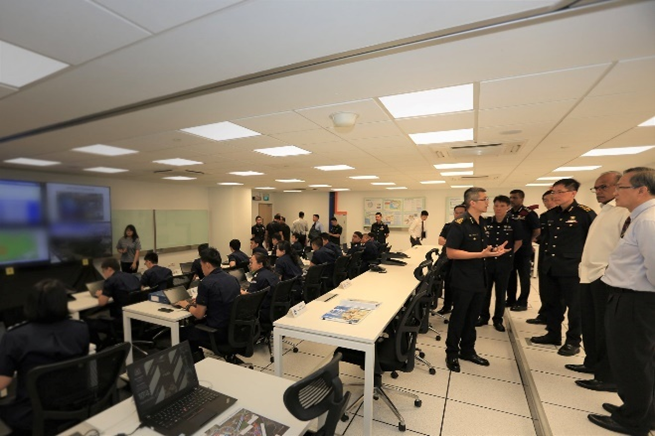
Mr K Shanmugam, Minister for Home Affairs, being briefed on the Home Team Command Post within the Home Team Joint Facility, during the official opening of the Kallang Fire Station on 9 October 2019. Photo: Singapore Civil Defence Force
The Kallang Fire Station was opened on 9 October 2019, with the site also housing the Home Team Joint Facility, a first-of-its-kind facility designed to function as a command and staging area for Home Team Units during joint operations for major events.
2019
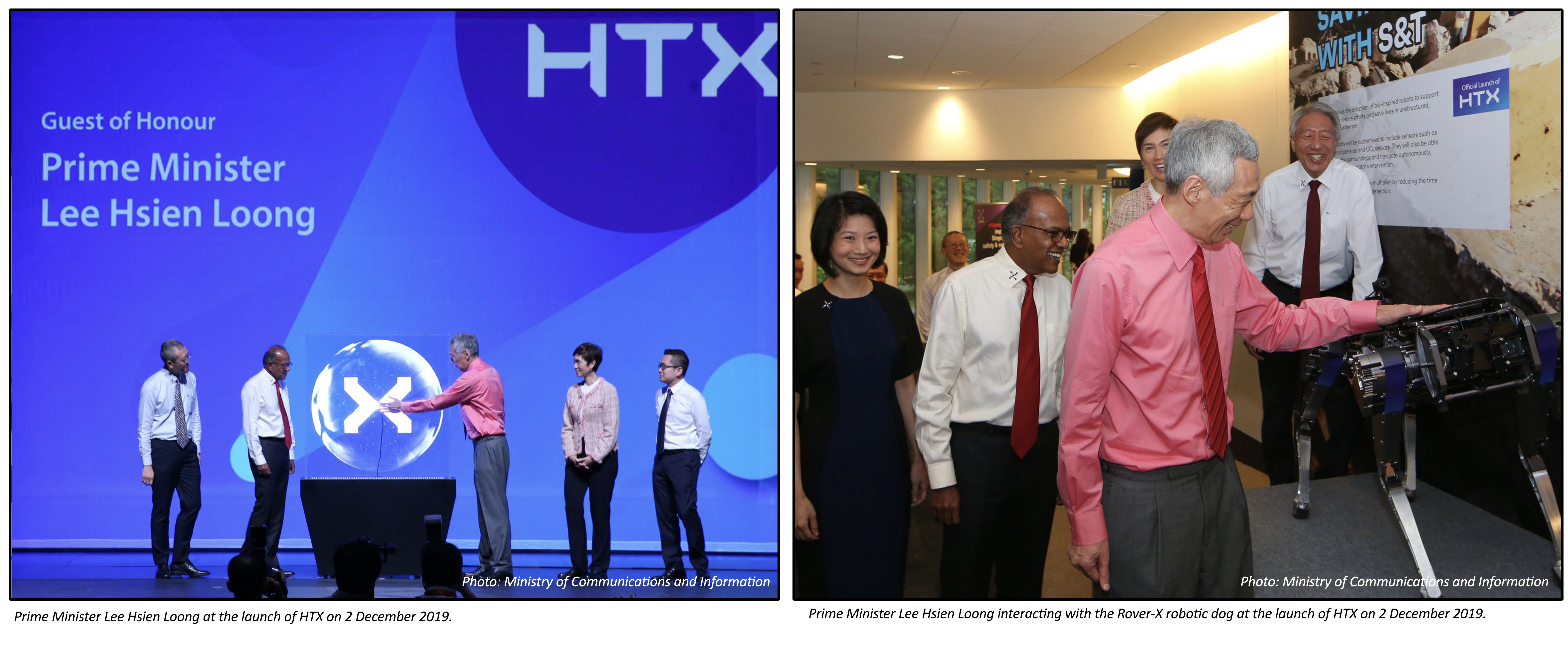
The Home Team Science and Technology Agency (HTX) was launched as a statutory board under MHA on 2 December 2019. HTX harnesses science and technology (S&T) and serves as the Home Team’s force multiplier to exponentially enhance the Home Team’s operations to keep Singapore safe and secure.
2020
The Singapore Corporation of Rehabilitative Enterprises (SCORE), a statutory board under MHA, was rebranded as Yellow Ribbon Singapore (YRSG) in May 2020. The term “Yellow Ribbon” has been synonymous with second chances for reformed ex-offenders, and the rebranding serves to strengthen its association in the public eye, with its mission to champion the reintegration of ex-offenders into society.
2020
-01.tmb-medium.png)
The updated Home Team family of logos representing the Ministry Headquarters and all 10 Home Team agencies, together with the refreshed MHA Vision and Mission, are part of the Home Team corporate branding.
MHA reviewed our Vision, Mission and Core Values in 2020 to better reflect our collective aspiration in fulfilling the Ministry’s goals and responsibilities. Thousands of Home Team leaders and officers were engaged since March 2019 to identify core elements that were critical for the Home Team’s success. The revised MHA Vision and Mission are reflected below. The Core Values of Honour and Unity remain unchanged but the definitions have been updated.
Vision
“A Trusted Home Team, A Safe and Secure Singapore”
Mission
“We work together as one Home Team, and in partnership with the community, to keep Singapore safe and secure”