
Speeches
NUS Law Freshmen Inauguration Ceremony – Speech by Mr K Shanmugam, Coordinating Minister for National Security and Minister for Home Affairs
26 July 2026
Professor Andrew Simester
Members of the faculty,
Distinguished guests,
Parents and family members,
And most importantly, our newest law students,
Introduction
1. Good afternoon.
2. Congratulations to all the students. Admission to NUS Law is a significant achievement. It is an aspiration for many and achieved only by a few. The Law Faculty has a reasonable claim to be considered to be world class.
3. To the parents and families here today, congratulations as well. Your support has helped your sons and daughters get here.
4. An occasion like this is joyous. Looking to the future. Celebratory.
5. But we in Singapore, have made paranoia, an art form. At least in Government. On the motto that: Only the paranoid survive.
6. So I am going to talk about a topic that has been recently in the news. Because it is current. and relevant for you, as it will affect you directly.
7. Last month, the Law Society published some key findings from a study it had commissioned – on the issue of attrition of lawyers.
8. Practitioners and former lawyers had been interviewed. They described their experiences and their reasons for leaving.
9. Some of the difficulties mentioned, included long hours, toxic workplace culture, pressure, the derogatory / unfair treatment they received in Court, whether legal practice remains a sustainable career, and the impact of AI on lawyers.
10. You will find a range of views on attrition: From people who will say it is not a problem, to those who might cast it as a most serious issue facing the profession.
Attrition from the Profession
11. To understand the issue, it is best to start with data.
12. The data shows that attrition has remained broadly stable over the last 10 years.
13. Minister for Law Edwin Tong gave the figures in Parliament in May. Between 2015 and 2024, about 60% of lawyers remained in practice after working for five years. About 40% remained after ten years.
14. The profession has actually grown since 2015. The number of Singapore lawyers in practice grew by a quarter, 26% to be exact. We also have about 4,800 in-house counsel in Singapore, a one-third increase since 2015.
15. The rate of attrition is stable over the past 10 years. And the size of the profession has grown steadily.
16. But that does not mean there is no problem, and everything is okay.
17. But the data gives you a broad sense.
18. The next step is to go look at the reasons why about 40% of the lawyers leave practice after five years.
19. Some of the reasons are perfectly understandable.
20. Law school and legal practice train you to think clearly, argue logically, and write precisely
21. You also learn to exercise judgment under pressure.
22. These are valuable qualities that serve you well in many fields.
23. Many lawyers, after a few years, decide to go into other fields: investment banking, join the public service, start a business, pursue their passion after having gotten a law degree mainly to satisfy their parents who tell their children to get a professional degree first.
24. Some of my best assistants have gone on to start pastry shops and restaurants, joined family businesses, joined the charity sector, Banking, and in-house counsel.
25. Some also have the means to say, “ I don’t really want to work as a lawyer. I want a different pace, a different rhythm. I want to travel.” And so on.
26. After you account for lawyers who leave for these and other such reasons, then you drill down to the remainder who leave because of push factors.
27. The law society study highlighted issues. And I referred to them earlier.
28. Some serious questions have been raised.
29. The Law Society has said that it is forming a Taskforce to consider how to deal with these issues.
30. The Judiciary and the Law Society are also setting up a joint committee to study this feedback and see what can be done to deal with the issues that have been identified.
31. It is good that they are doing this.
32. I have shared my views on the study with the Law Minister. The survey sets out the direct experiences of lawyers. It is important that the profession and the Courts deal with this. At the same time, it is important to get more detailed, objective data to get a sense of the extent of the problem. Statistically, how many lawyers have such complaints? And second, you also have to get a sense from the law firms, and the Courts to get their perspective on these issues.
33. You need to size the problem and verify it, and then deal with it.
Demands of Top-End Practice
34. Even as we speak about this, aspiring lawyers like you have to be clear about what you want and the trade-offs you have to make.
35. If you choose to be in legal practice, and you want to be at the top-end, the cutting edge, then you must expect the demands to be very high.
36. Our competition is from other top class legal centres. Clients demand the best. They can compare.
37. At the very top, it is a demanding, taxing profession that requires a lot from the lawyers.
38. And the remuneration is linked to the demands.
39. Let me give you some data.
40. The pay at a top local firm for a first year qualified lawyer can be more than $100,000 annually, like $120,000 to $140,000 in the very top firms.
41. In the smaller law firms, it might be somewhat lower.
42. The salaries for lawyers generally tend to be higher than for other professions including doctors.
43. After six to eight years in a law firm, the best performers can make it as junior partners.
44. At the top-end, you could then expect to make perhaps $200,000 to $300,000 annually.
45. And if you join the Government, the Legal Service and the Judicial Service pay competitively so that they can attract talent. Not exactly the same as the top performers, but competitive, taking into account the different pressures and demands.
46. When you get paid like that , then the expectations and demands will also be high.
47. Work is expected almost round the clock.
48. It is even more intense in London, New York.
49. The pressure comes with the territory.
50. So it’s a choice. You want that?
51. Or do you want a different pace of life? Then you must choose a firm that makes quality of life a part of its work culture. There are firms like that.
52. But let me also be clear.
53. None of what I have said about law being a demanding profession excuses poor supervision, lack of training, harassment, bullying, and unreasonable treatment of lawyers.
54. These issues need to be taken seriously.
Singapore’s Legal Industry
55. I will make another point about
the legal profession. Again useful for you to know, as you enter law school.
56. You are taking the first step to enter the legal profession which has generally been successful.
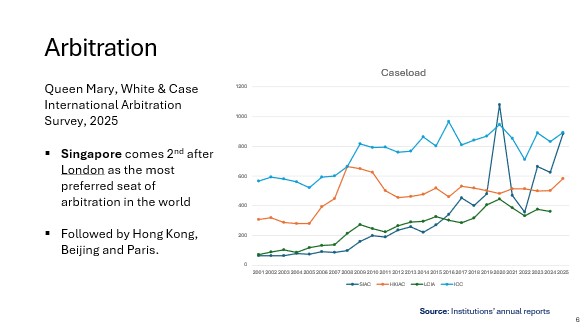
57. The reason for the success is twofold: (1) Policies which have generated economic growth, and (2) Our adherence to the Rule of Law.
58. Without the macro-economic growth, the legal profession will not be where it is now, and not many will want to get into it. Legal profession thrives when Businesses thrive.
59. For many years, the Government has pursued economic growth to benefit Singaporeans. And the legal profession has grown in tandem.
60. The result is we have a very substantive legal profession in Singapore, when you compare it in proportion to our population.
61. Take South Korea as a reference. G20 country. One of the 20 largest economies in the world. World-class industries and firms. About 50 million citizens. That is nearly 15 times our citizen population. GDP of about 1.8 trillion US dollars, more than three times ours.
62. Yet, Singapore has around 6,400 lawyers, and South Korea has 34 thousand.
63. You look at large law firms with more than 250 lawyers. We have four. South Korea has nine.
64. Another way to compare: In Singapore, there is around 1 lawyer for every 570 citizens. South Korea has about 1 lawyer for every 1470 citizens.
65. This gives you a sense of the size of our legal profession, relative to our population.
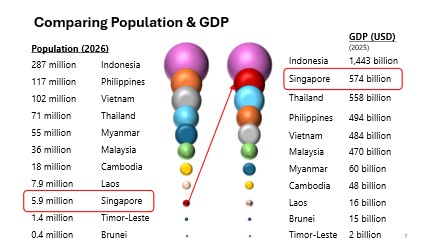
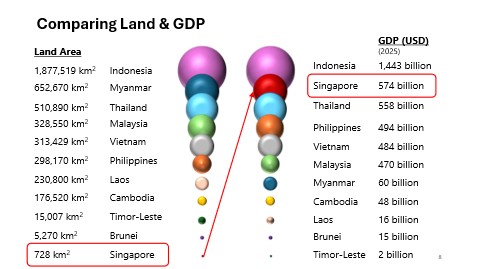
66. We don’t have any resources so we focus on our people and our service industries, including our legal sector.
67. So far, we have been successful.
68. Take arbitration as an example.
69. Today, we are a leading global arbitration hub. We are second, after London, as the most preferred seat of arbitration in the world.
70. This was a result of deliberate active Government policy over many years, since the mid-2000s, including making the necessary legislative changes.
71. We took a number of steps, which I won’t go into here, that propelled us to near the top in attracting work.
72. But even as we speak, the Law Minister has just returned from New Delhi, where he was promoting arbitration in Singapore. We have done this across major centres: China, India, Saudi Arabia, and other places for several years. Arbitration cases from India form a significant percentage of the arbitrations done in Singapore, bringing work for Singapore lawyers.
73. But our success in arbitration and more broadly in our economy cannot be taken for granted.
74. It is a work in progress. We have to continually compete and keep improving.
75. And as we improve, others will look at what we do and try and catch up, or overtake.
76. They will succeed unless we continue to outperform.
77. Outperform is a word I will leave with you.
78. One example of outperformance which helps our legal sector.
79. Look at our GDP in relation to our population size:
And now our land size:
81. And our success - Singapore’s financial and economic success is underpinned by our adherence to the Rule of Law.
82. Investors know: here the Rule of Law applies.
83. MNCs, other investors trust that their money is safe here. The legal framework provides certainty and stability. Contracts are enforced. The Courts are well functioning and credible.
84. You will learn about the Rule of Law in Law School. When you do, remember that it is not just theory. The practice of it is essential to our success.
Conclusion
85. This was a somewhat serious speech for an occasion like this.
86. But I decided to say these things because they are relevant.
87. You are all young, bright and mature.
88. These are important things to know about law and about Singapore. To help you make wiser choices in law school, and after law school, when you decide what you want to do.
89. Congratulations once again to all of you.
90. Thank you.