
Meet Our Community
All in a day’s work: courtroom, reinvented
3 July 2026
Home Team
HTX
MHA
SPS
For SUPT An Koh Shian, justice is not just an ideal — it is something you design, build and fight for. Here is his story.
Written by Poh Jinn Yang
PHOTO: SPS. GRAPHIC: Poh Jinn Yang
Bringing the courtroom to the inmate — not the other way around — was the goal. SUPT An, Senior Assistant Director (Reception Operations), Sentence Management Branch, Operations Division, was part of the team that made it happen.
Officially opened on 29 April 2026 at the Changi Prison Complex, the Singapore Prison Service (opens in new tab)’s (SPS) purpose-built video court facility marks a significant step forward in enhancing court operations. Developed in collaboration with the Ministry of Home Affairs (opens in new tab) Headquarters (MHQ), Home Team Science and Technology Agency (opens in new tab) (HTX) and the Judiciary, the facility replaces earlier retrofitted spaces and expands the number of video conferencing-enabled rooms and cubicles from 17 to 81, nearly five times more.
Home Team News interviewed SUPT An, who was part of the team that conceptualised and implemented the facility. He shares the journey behind the project, the lessons learnt and how innovation has played a part in enhancing court operations.
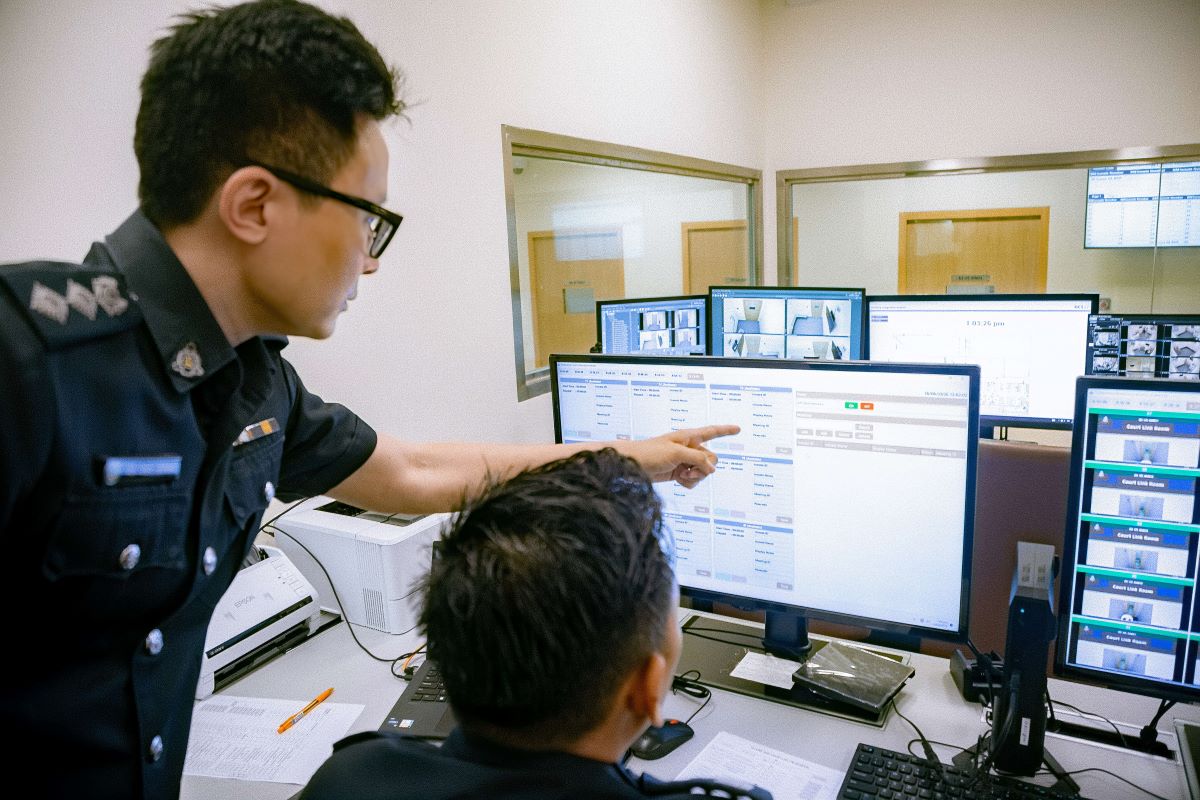
SUPT An guides an SPS officer in the Control Centre of the video court facility, where staff maintain oversight across all the rooms in the facility. PHOTO: Claire Tan
Why did SPS embark on having a video court facility?
SUPT An: As more court hearings shifted to video conferencing over the years, it became clear that we needed to expand our facilities and adapt how we conduct court hearings. We wanted a purpose-built facility that could support this growing demand while making court operations safer, more efficient and more reliable.
Conducting hearings remotely reduces the need to physically escort inmates to court, which lowers security and operational risks. It also improves the timeliness of court proceedings and helps ensure continuity of operations during periods of disruption, such as the COVID-19 pandemic.
Today, the expanded facility supports a broader range of court proceedings than before, strengthening SPS's ability to meet growing operational demands while maintaining the integrity of the judicial process.
What’s one interesting insight about video courts?
SUPT An: With 80 to 90 video court hearings conducted daily, the facility was purpose-built with users in mind. Features such as digital queue systems, improved acoustics and accessibility provisions for inmates with disabilities make hearings smoother, more orderly and more accessible.
These features reflect SPS's commitment to designing services that are not only efficient, but also inclusive and centred on users’ needs.
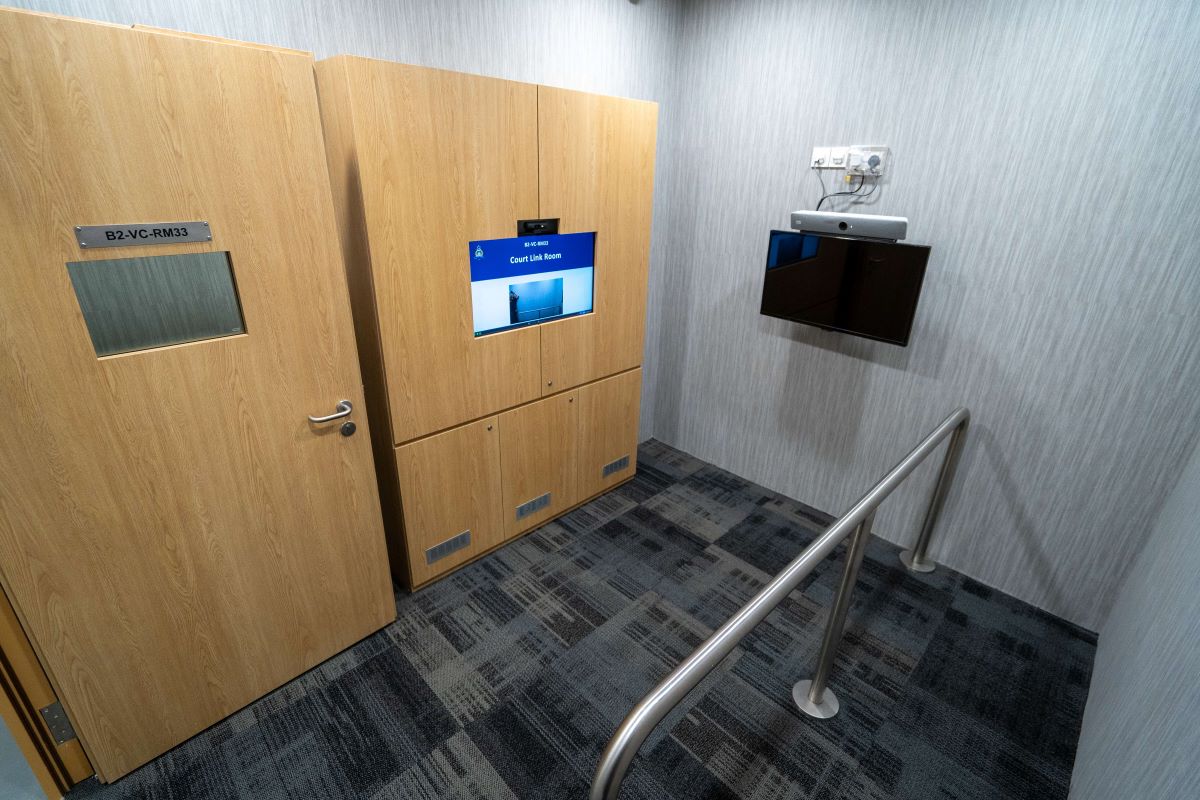
A video conferencing-enabled room, designed to ensure accessibility for inmates with mobility constraints. PHOTO: SPS
Describe an instance when the project did not go as planned. How did the Home Team (HT) agencies involved in this project respond together?
SUPT An: We began planning for the project in February 2019, but the COVID-19 pandemic disrupted the implementation timeline and operating assumptions. There was an urgent need to ensure that court hearings could continue safely and in a timely manner amidst public health restrictions. SPS, MHQ, HTX and the Judiciary worked closely together to accelerate interim solutions. In 2020 and 2021, immediate retrofitting works were carried out to construct additional video conferencing cubicles, enabling significantly higher volume of hearings to be conducted remotely and safely.
The experience reinforced the importance of building resilience and flexibility into operational systems. The project scope was thus expanded in 2022 to future-proof court operations. MHQ and SPS worked with the Judiciary to refine the operational and technical requirements, while HTX designed and implemented the supporting infrastructure.
A key learning point for me was the value of strong cross-agency collaboration and adaptability in responding to evolving circumstances. By working together and adjusting plans when circumstances changed, we delivered a solution that addressed immediate operational needs while strengthening the long-term resilience of court processes.
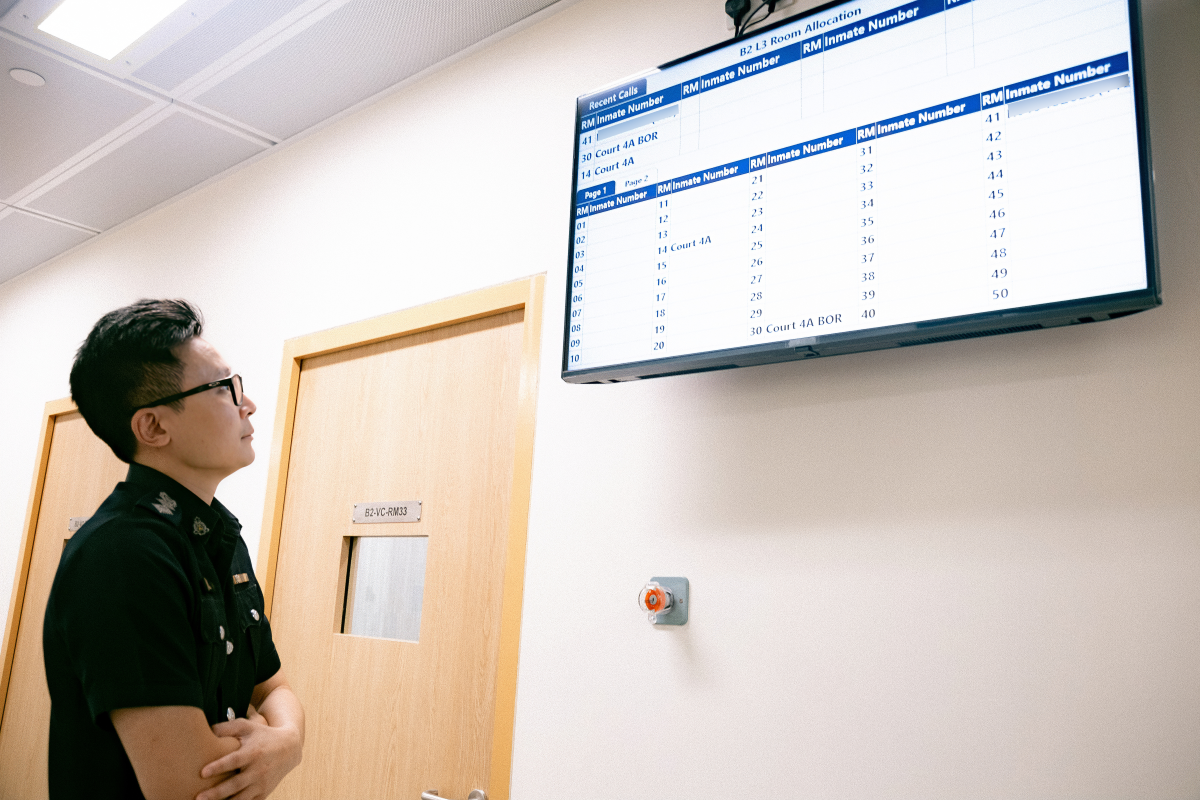
SUPT An observes the digital queue management system, which improves coordination of inmate movements within the facility. PHOTO: Claire Tan
What feedback have you received from inmates and how do you feel about having a part to play behind the feedback?
SUPT An: The feedback has generally been positive. Some inmates have shared that the facility is user-friendly. They also appreciate that hearings can be conducted efficiently without the need to be physically escorted to court.
For me, it is meaningful to be part of a project that not only improves operational efficiency, but also makes the process more orderly, accessible and timely for those involved.
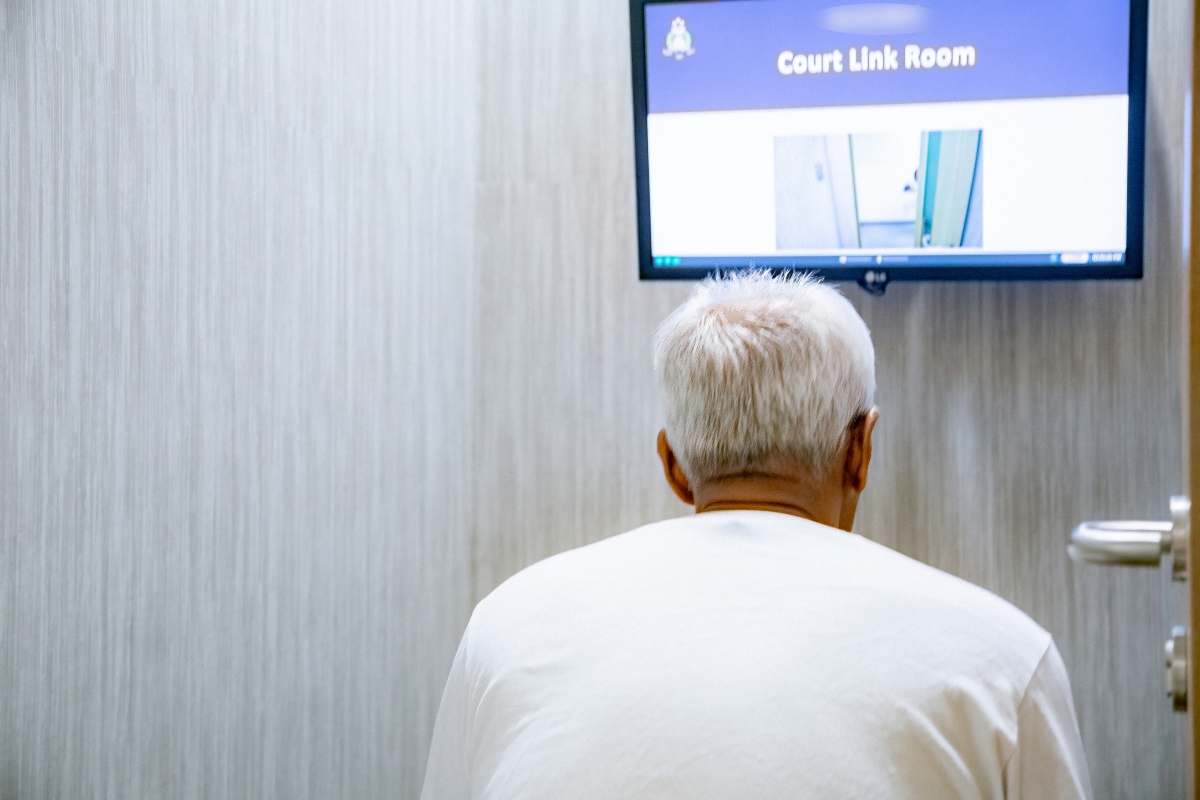
An inmate waits in a soundproof video conferencing-enabled cubicle before his court hearing. The feature accords privacy while minimising disruptions during proceedings. PHOTO: Claire Tan
What aspects of the video court hearing system do you hope can be further enhanced?
SUPT An: The facility provides a strong foundation for continued innovation. As technology continues to evolve, there may be opportunities to further enhance the user experience through improved video and audio capabilities, smarter scheduling and queue management systems and more seamless integration with digital workflows across agencies.
These enhancements could make court proceedings even more efficient and accessible while maintaining the fairness, security and integrity of the judicial process.
From your experiences in this project, what are your views on HT agencies collaborating to use new technology in operational processes?
SUPT An: What stood out to me was how every agency brought different expertise to the table, and how that collective effort helped shape a solution that was practical, secure and future-ready.
Technology works best when it is supported by strong partnerships, shared objectives and a willingness to adapt processes thoughtfully. This project is a good example of how collaboration can transform an operational need into a long-term capability that benefits the wider justice system.
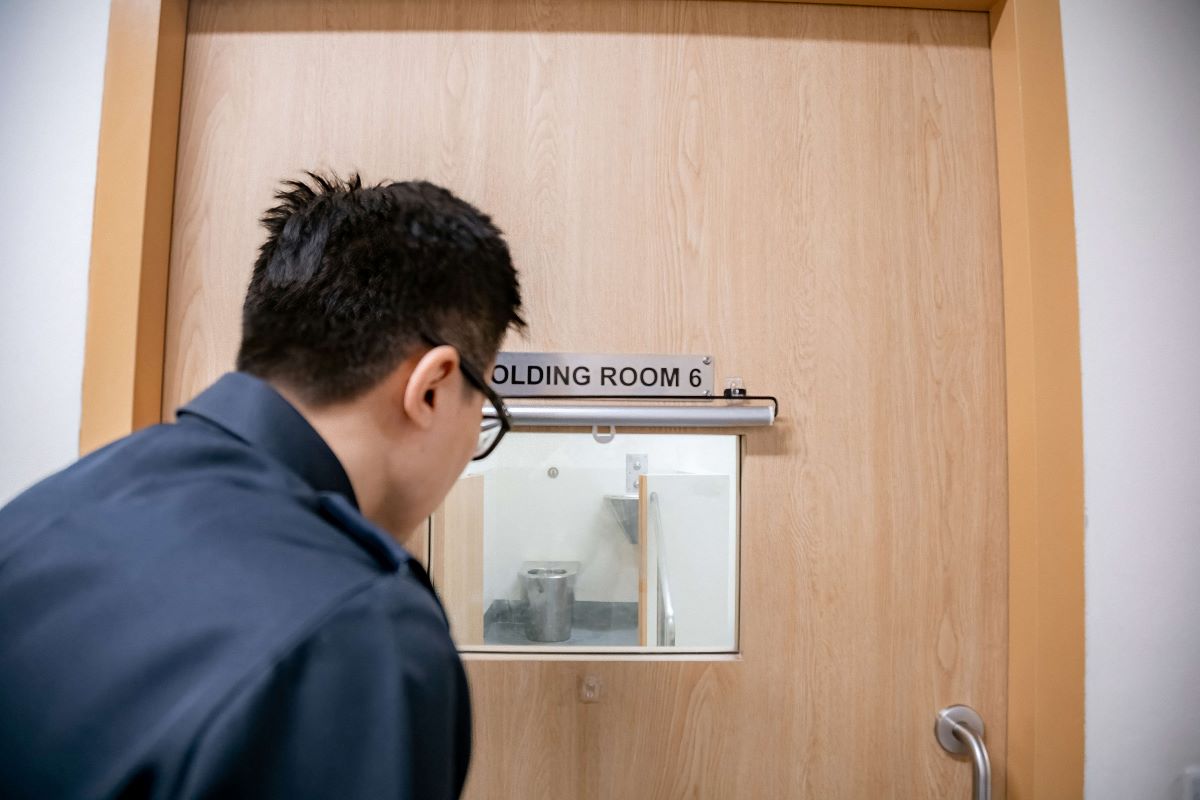
SUPT An peers through the glass pane of a holding cell, where inmates wait before being escorted to a video conferencing-enabled room or cubicle for their hearing. PHOTO: Claire Tan
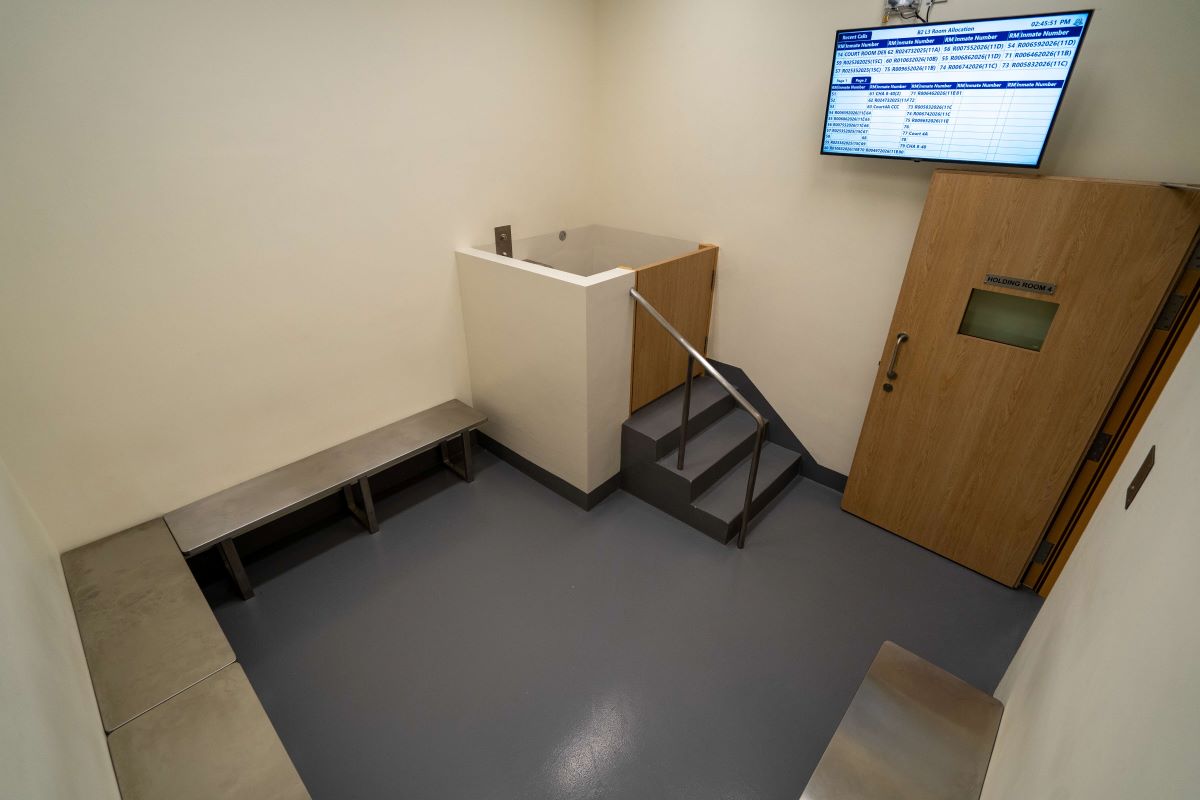
Holding cell equipped with toileting facility and a digital queue display screen. PHOTO: SPS